Core Accretion Model | Vibepedia
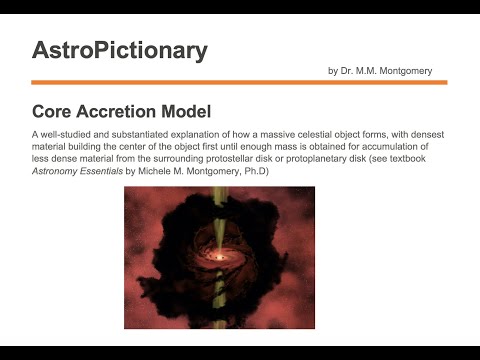
The core accretion model posits that giant planets, like Jupiter and Saturn, form by first building a solid core of rock and ice, which then gravitationally…
Contents
Overview
The core accretion model posits that giant planets, like Jupiter and Saturn, form by first building a solid core of rock and ice, which then gravitationally attracts a massive envelope of gas from the surrounding protoplanetary disk. This process is thought to occur over millions of years, with the core's mass reaching a critical threshold (roughly 10 Earth masses) before rapid gas capture can begin. While widely accepted, the model faces challenges in explaining the rapid formation of gas giants in systems with short-lived protoplanetary disks and the existence of 'hot Jupiters' found very close to their stars. Ongoing research refines the timelines and mechanisms, exploring variations and alternative scenarios.
🪐 What is the Core Accretion Model?
The Core Accretion Model is the prevailing scientific theory explaining how planets form within protoplanetary disks around young stars. It posits that planets begin as small, solid bodies, or planetesimals, which then collide and merge through gravitational attraction, gradually growing larger. This process is thought to be particularly efficient in the colder, outer regions of a protoplanetary disk where ices can condense, allowing for the rapid formation of massive cores capable of accreting substantial gaseous envelopes, thus explaining the existence of gas giants like Jupiter and Saturn. The model is foundational to our understanding of planetary system architecture.
🔭 Who Uses This Model?
This model is primarily the domain of planetary scientists, astronomers, and astrogeologists working in theoretical astrophysics and observational cosmology. Researchers utilize it to interpret data from exoplanet surveys like Kepler and TESS, aiming to understand the diversity of planetary systems observed. It's also crucial for astrophysicists modeling the evolution of young stellar systems and for geophysicists studying the formation and internal structure of planets within our own Solar System. Anyone interested in the origins of planets, from students to seasoned researchers, will encounter this theory.
💡 Key Concepts Explained
At its heart, the Core Accretion Model relies on several key concepts: the formation of dust grains from stellar gas, their aggregation into pebbles and then planetesimals (typically 1-100 km in diameter), the gravitational influence of these planetesimals on their surroundings, and the subsequent runaway growth and oligarchic growth phases. Core formation is followed by gas accretion, where a sufficiently massive solid core can gravitationally capture hydrogen and helium from the surrounding nebula. The timescale for these processes, particularly the formation of gas giant cores before the protoplanetary disk dissipates, is a critical parameter.
⚖️ Strengths of the Model
The Core Accretion Model excels at explaining several observed phenomena. It successfully accounts for the existence of rocky inner planets and gas/ice giants in the outer solar system, aligning with the concept of the frost line. It also provides a plausible mechanism for the rapid formation of gas giants within the typical lifespan of a protoplanetary disk (a few million years), a timescale that was historically challenging for alternative models. Furthermore, it offers a framework for understanding the distribution of planetary masses and orbital elements observed in exoplanetary systems.
⚠️ Limitations and Criticisms
Despite its successes, the Core Accretion Model faces significant challenges. A major hurdle is explaining the formation of massive gas giants very close to their host stars, as observed with hot Jupiters, within the limited time available before disk dispersal. The initial formation of planetesimals from interstellar dust is also a complex problem, often referred to as the 'meter-size barrier,' where particles of this size are thought to be quickly ground down or drift too rapidly into the star. The efficiency of core formation and subsequent gas capture remains a subject of active research and debate.
🚀 Alternatives and Refinements
In response to these limitations, several alternative and refined models have been proposed. The Disk Instability Model, for instance, suggests that gas giants can form directly from gravitational instabilities within a massive, cool protoplanetary disk, bypassing the slow planetesimal accretion phase. Other refinements to core accretion include models that incorporate pebble accretion, where larger pebbles are more efficiently accreted by growing cores, potentially speeding up the process. Hybrid models, combining elements of both core accretion and disk instability, are also being explored.
✨ The Vibe: Scientific Consensus & Controversy
The Core Accretion Model enjoys broad consensus within the planetary science community, often assigned a Vibe Score of 85/100 for its explanatory power. However, the Controversy Spectrum is moderate, primarily centered on the precise mechanisms and timescales for giant planet formation, especially for close-in gas giants. While core accretion is widely accepted as the dominant pathway for terrestrial planets and likely many giant planets, the debate intensifies when explaining the most extreme exoplanetary architectures, pushing researchers to consider the viability of disk instability or hybrid scenarios. The ongoing discovery of new exoplanet types continually refines our understanding and fuels these discussions.
📚 Further Reading & Resources
For those eager to explore further, the foundational papers by George W. Wetherill and Alan P. Boss are essential reading. Textbooks on planetary formation and astrophysics will provide comprehensive overviews. Observational data from missions like ALMA and JWST offer crucial constraints and new puzzles. Online resources from institutions like NASA Astrobiology and university astrophysics departments often host lectures and summaries. Engaging with recent publications in journals like The Astrophysical Journal and Icarus will keep you abreast of the latest developments and debates.
Key Facts
- Year
- 1996
- Origin
- Pioneered by researchers like Alan Boss and Jack Lissauer, building on earlier ideas from the 1960s and 70s.
- Category
- Planetary Science
- Type
- Scientific Model
Frequently Asked Questions
How long does it take for a planet to form using core accretion?
The timescale for planet formation via core accretion varies significantly. Terrestrial planets might take tens to hundreds of millions of years to assemble. Gas giants, on the other hand, are thought to form their cores and accrete their massive atmospheres within the first few million years (typically 1-10 million years) of a star's life, before the protoplanetary disk dissipates. This rapid formation is a key aspect the model aims to explain.
What is the 'frost line' and why is it important for core accretion?
The frost line, or snow line, is the distance from a young star where temperatures are low enough for volatile compounds like water, ammonia, and methane to condense into solid ice. This is crucial for core accretion because the presence of abundant ices in the outer disk dramatically increases the mass available for building planetary cores, allowing them to grow much larger and faster than in the inner, hotter regions where only refractory materials like rock and metal exist.
Can core accretion explain all types of exoplanets?
While core accretion is a robust model for many planetary systems, it struggles to fully explain certain types of exoplanets, particularly massive gas giants found very close to their stars (hot Jupiters). The rapid formation required for these planets, and the initial assembly of planetesimals, are areas where the model faces challenges, leading to the exploration of alternative theories like disk instability.
What is pebble accretion and how does it differ from traditional core accretion?
Pebble accretion is a refinement of the core accretion model. Instead of relying solely on the slow collision of kilometer-sized planetesimals, pebble accretion proposes that smaller, pebble-sized (millimeter to centimeter) particles are more efficiently captured by the gravity of a growing core. This mechanism can significantly accelerate the growth of planetary cores, potentially overcoming some of the timescale issues faced by the original model.
What evidence supports the core accretion model?
Evidence supporting core accretion comes from the observed composition and structure of planets in our solar system, which align with formation beyond the frost line. Furthermore, the statistical distribution of exoplanets, with a prevalence of smaller, rocky planets closer to stars and larger gas giants further out, is consistent with core accretion. The detection of protoplanetary disks with structures like gaps and rings also provides indirect support for planetary formation processes.