Hot Jupiters | Vibepedia
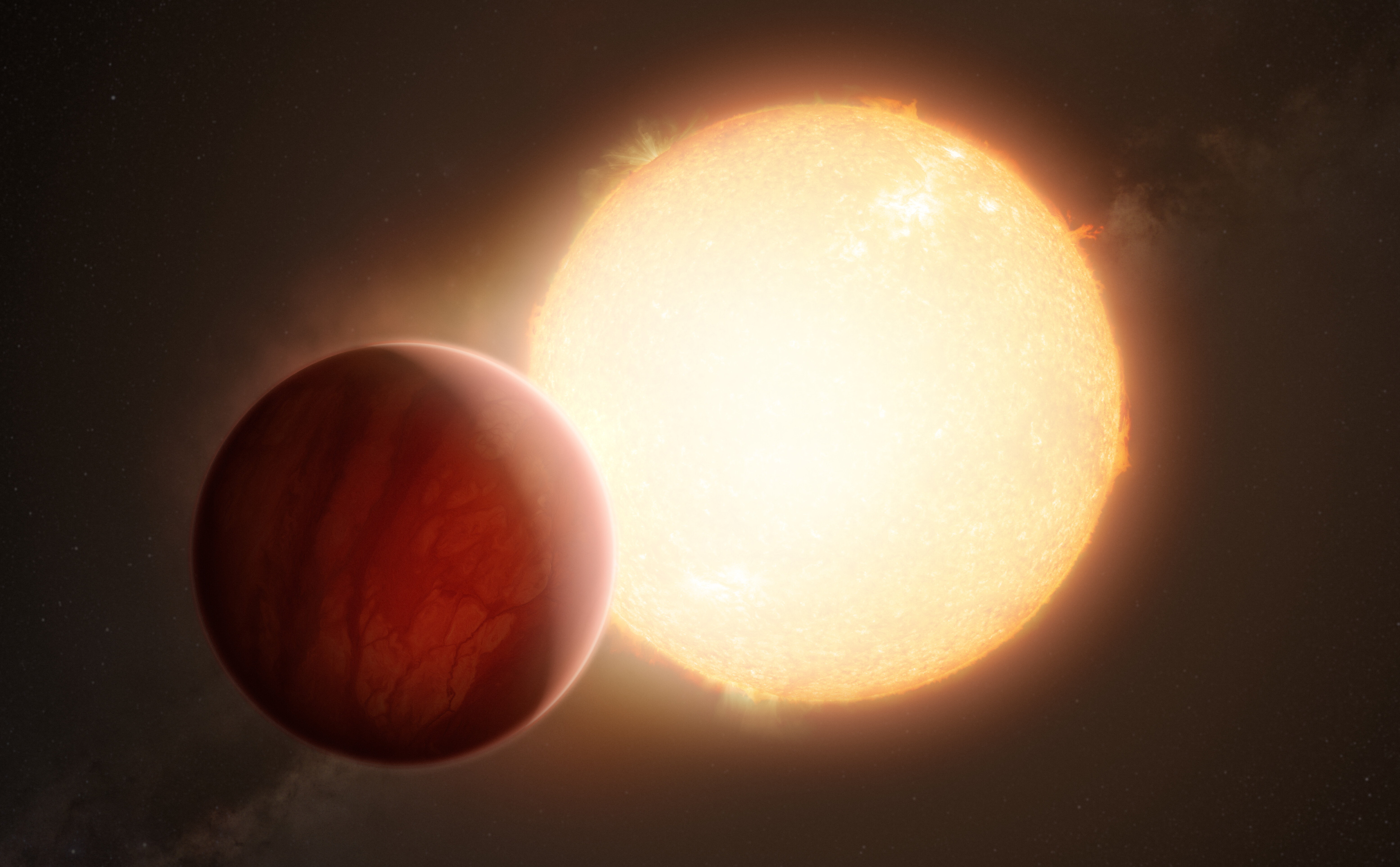
Hot Jupiters represent a fascinating class of exoplanets, defined by their gas giant composition akin to Jupiter itself, but with a crucial distinction: they…
Contents
Overview
Hot Jupiters represent a fascinating class of exoplanets, defined by their gas giant composition akin to Jupiter itself, but with a crucial distinction: they orbit their host stars at incredibly close distances. This proximity subjects them to extreme stellar radiation, resulting in scorching atmospheric temperatures and earning them their evocative moniker. Their large mass and close orbits make them relatively easy targets for detection using methods like the radial-velocity method, which measures the wobble of a star caused by a planet's gravitational pull. The discovery of 51 Pegasi b revealed the existence of these extreme worlds and fundamentally altering our understanding of planetary system formation. These planets challenge conventional models, forcing astronomers to reconsider how gas giants can form so near to their stars or migrate inward.
🎵 Origins & History
The concept of planets orbiting other stars, let alone gas giants in such extreme proximity, was largely theoretical until the mid-1990s. The early radial-velocity surveys like the Geneva Extrasolar Planet Search Programme were instrumental in identifying these 'hot Jupiters,' which provided the first concrete evidence that planetary systems could be vastly different from our own Solar System.
⚙️ How It Works
Hot Jupiters function as extreme examples of planetary dynamics. Their defining characteristic is their orbital period, which places them within the star's habitable zone or even closer. This proximity results in atmospheric temperatures that can lead to unique atmospheric phenomena such as "blown-out" atmospheres where lighter elements are stripped away by stellar winds. The immense gravitational influence of a hot Jupiter on its star causes a significant stellar wobble, detectable through the Doppler shift in the star's light. This effect is amplified by the planet's mass, which is comparable to or greater than Jupiter's, and its rapid orbital speed. Their existence also raises questions about their formation location; many are thought to have formed further out in their protoplanetary disks and migrated inward, a process known as planetary migration, possibly due to interactions with the disk or other planets.
📊 Key Facts & Numbers
The Kepler Space Telescope mission, which employed the transit method, identified thousands of exoplanet candidates, with hot Jupiters being a prominent subset. These planets often have radii that can be larger than Jupiter's due to atmospheric inflation from stellar irradiation. The detection rate suggests that hot Jupiters might be common, though this figure is subject to observational biases.
👥 Key People & Organizations
Key figures in the discovery and study of hot Jupiters include Michel Mayor and Didier Queloz. Other pivotal researchers include Geoffrey Marcy and R. Paul Butler, whose work with the radial-velocity method led to numerous exoplanet discoveries. The Kepler mission team, led by scientists at NASA Ames Research Center, revolutionized exoplanet detection through its transit photometry. Major institutions like the Max Planck Institute for Astronomy in Germany and the Harvard-Smithsonian Center for Astrophysics in the U.S. have been at the forefront of exoplanet research, operating key observatories and developing theoretical models. The Transiting Exoplanet Survey Satellite (TESS) mission continues to discover new exoplanets, including potential hot Jupiters, around nearby stars.
🌍 Cultural Impact & Influence
The discovery of hot Jupiters has profoundly reshaped our understanding of planetary system formation and evolution, moving beyond the Earth-centric view of the Solar System. These extreme worlds have captured the public imagination, appearing in science fiction and popular science discussions as prime examples of the universe's strangeness. They have spurred the development of new theoretical models that attempt to explain their existence, such as theories of planetary migration and atmospheric inflation. The study of their atmospheres, using instruments like the Hubble Space Telescope and the James Webb Space Telescope, provides unprecedented insights into planetary chemistry under extreme conditions, influencing fields from atmospheric science to astrobiology by highlighting the vast range of possible planetary environments. The sheer existence of these planets challenges the notion that planetary systems must resemble our own.
⚡ Current State & Latest Developments
Current research on hot Jupiters is focused on refining atmospheric characterization and understanding their formation pathways. The James Webb Space Telescope (JWST) is currently providing unprecedented data on the atmospheric composition of these planets, detecting molecules like water, methane, and carbon monoxide, and mapping temperature variations. Missions like PLATO are designed to discover and characterize more exoplanets, including potentially cooler versions of hot Jupiters. Astronomers are also investigating the role of stellar activity, such as flares and coronal mass ejections, in shaping the atmospheres and habitability potential of planets orbiting close to their stars. The ongoing debate about whether hot Jupiters can form in situ or must migrate inward continues to drive theoretical and observational efforts.
🤔 Controversies & Debates
One of the most significant debates surrounding hot Jupiters concerns their formation mechanism. The prevailing theory suggests that they form in the outer, colder regions of a protoplanetary disk, similar to Jupiter, and then migrate inward through gravitational interactions with the disk or other planets. However, some models propose that they could form closer to their stars, a process that remains challenging to explain given the scarcity of solid material in the inner disk. Another area of contention is the extent of atmospheric inflation; while stellar irradiation is known to heat and expand planetary atmospheres, the precise mechanisms and their upper limits are still debated. Furthermore, the potential for habitability, even in a very broad sense, on hot Jupiters is a subject of ongoing discussion, with some researchers exploring the possibility of life in hypothetical atmospheric layers or moons.
🔮 Future Outlook & Predictions
The future of hot Jupiter research promises exciting advancements. With the continued operation of the James Webb Space Telescope (JWST) and the upcoming Nancy Grace Roman Space Telescope, astronomers will be able to probe the atmospheres of these planets with even greater detail, searching for biosignatures or evidence of complex chemistry. Future missions may focus on detecting smaller, rocky planets in similar close orbits, often termed 'hot Earths' or 'super-Earths,' which could offer different insights into planetary formation and atmospheric retention. Theoretical models will continue to evolve, incorporating new observational data to refine our understanding of migration, atmospheric dynamics, and the diversity of planetary architectures across the galaxy. The search for exoplanets is also expanding to include stars of different types and ages, potentially revealing hot Jupiters in unexpected environments.
💡 Practical Applications
While hot Jupiters themselves are unlikely candidates for direct human habitation due to their extreme temperatures, their study has significant practical applications in advancing astronomical instrumentation and da
Key Facts
- Category
- science
- Type
- topic