Medical Literacy | Vibepedia
Medical literacy, often used interchangeably with health literacy, encompasses a complex interplay of cognitive, social, and cultural factors that influence…
Contents
Overview
The concept of medical literacy, or health literacy as it's more commonly known, emerged from a growing awareness in the latter half of the 20th century that simply providing health information was insufficient. Early research on [[thalidomide|thalidomide]]'s tragic consequences in the 1960s highlighted how misunderstanding instructions could lead to severe harm. By the 1980s and 1990s, public health professionals and researchers like [[ernest-g-anderson|Ernest G. Anderson]] began systematically investigating the link between literacy skills and health outcomes. The [[us-department-of-education|U.S. Department of Education]] conducted the 2003 National Assessment of Adult Literacy (NAAL) in the United States, which provided stark quantitative evidence. This landmark study solidified health literacy as a critical public health issue, moving it from a niche academic concern to a mainstream focus for policymakers and healthcare providers.
⚙️ How It Works
Medical literacy operates on multiple levels, involving both individual skills and systemic demands. At the individual level, it requires the ability to understand spoken and written health information, navigate complex healthcare systems (e.g., filling out forms, understanding insurance), communicate effectively with healthcare providers, and critically evaluate health information encountered through various channels, including the [[internet|internet]] and social media. Systemically, healthcare providers and institutions must present information in clear, accessible formats, employ plain language, and create environments that support understanding. For instance, a doctor explaining a diagnosis needs to avoid jargon and use analogies that resonate with the patient's background, while a hospital must ensure signage is easily decipherable for diverse populations. The interaction between these individual skills and systemic supports determines the overall level of medical literacy in a given encounter.
📊 Key Facts & Numbers
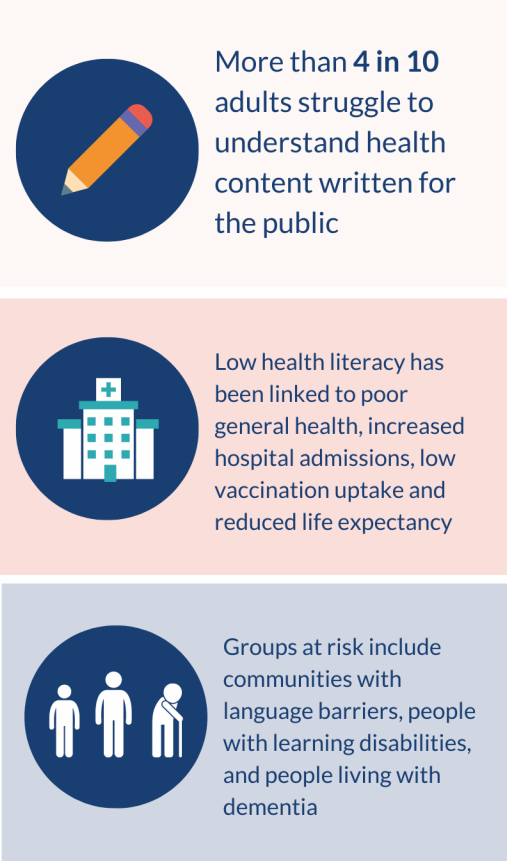
The scale of limited medical literacy is staggering. Globally, an estimated 50% of adults have difficulty understanding health information, a figure that can rise significantly in specific demographics and lower-income countries. In the United States, the 2003 NAAL report indicated that only 12% of adults had "proficient" health literacy, with 36% scoring at "basic" or "below basic." This deficit has tangible economic consequences, with estimates suggesting that limited health literacy costs the U.S. healthcare system between $50 billion and $100 billion annually due to increased hospitalizations, emergency room visits, and medication errors. For example, individuals with limited health literacy are reportedly 2.5 times more likely to be hospitalized than those with proficient health literacy, according to studies published by the [[agency-for-healthcare-research-and-quality|Agency for Healthcare Research and Quality (AHRQ)]].
👥 Key People & Organizations
Numerous individuals and organizations have championed the cause of medical literacy. Dr. [[rima-e-rudolph|Rima E. Rudolph]] and Dr. [[joan-k-donahue|Joan K. Donahue]] were instrumental in developing assessment tools and advocating for its importance in the early 2000s. The [[health-resources-and-services-administration|Health Resources and Services Administration (HRSA)]] in the U.S. has been a key government agency promoting health literacy initiatives, developing frameworks and resources for healthcare professionals. Non-profit organizations like the [[literacy-advocates-inc|Literacy Advocates Inc.]] and international bodies such as the [[world-health-organization|World Health Organization (WHO)]] also play crucial roles in research, policy development, and public awareness campaigns. Major academic institutions, including [[johns-hopkins-university|Johns Hopkins University]] and the [[university-of-north-carolina-at-chapel-hill|University of North Carolina at Chapel Hill]], host research centers dedicated to understanding and improving health literacy.
🌍 Cultural Impact & Influence
The influence of medical literacy extends far beyond individual health outcomes, shaping public health discourse and policy. When a significant portion of the population struggles to understand health information, it can impede the effectiveness of public health campaigns, such as those for [[vaccination|vaccination]] or disease prevention. For instance, the COVID-19 pandemic highlighted how misinformation and varying levels of medical literacy could impact public adherence to health guidelines and vaccine uptake. Furthermore, the concept has spurred innovation in health communication, leading to the development of patient-centered communication strategies, the use of visual aids, and the creation of "teach-back" methods where patients explain information in their own words to confirm understanding. This has also influenced the design of health-related technologies and digital platforms, pushing for greater user-friendliness and accessibility.
⚡ Current State & Latest Developments
In 2024 and beyond, the focus on medical literacy is intensifying, driven by the proliferation of health information online and the increasing complexity of healthcare. Initiatives are increasingly targeting digital health literacy, equipping individuals to discern credible sources from misinformation on platforms like [[tiktok-com|TikTok]] and [[facebook-com|Facebook]]. Healthcare systems are investing in "universal precautions" approaches, assuming all patients may have limited literacy and designing services accordingly. The development of AI-powered tools to simplify medical texts and provide personalized health explanations is also a rapidly evolving area. Regulatory bodies are also paying closer attention; for example, the [[food-and-drug-administration|U.S. Food and Drug Administration (FDA)]] continues to refine guidelines for clear and understandable drug labeling and patient information leaflets.
🤔 Controversies & Debates
A significant debate surrounds the terminology itself, with some arguing that "health literacy" places undue burden on the individual rather than acknowledging the systemic failures of healthcare systems to communicate effectively. Critics contend that focusing solely on individual deficits can stigmatize those with limited literacy and distract from the need for providers and institutions to adopt more accessible communication practices. Another controversy involves the measurement of health literacy; existing tools, like the [[health-activities-literacy-assessment-tool|Health Activities Literacy Assessment (HALA)]] or the [[new-est-health-literacy-scale|Newest Vital Sign (NVS)]], are effective but may not capture the full spectrum of skills needed in diverse cultural contexts or for complex conditions. The role of cultural beliefs and language barriers in medical literacy also remains a complex area, with ongoing discussions about how best to address these multifaceted challenges.
🔮 Future Outlook & Predictions
The future of medical literacy will likely be shaped by advancements in artificial intelligence and personalized medicine. AI is poised to play a significant role in translating complex medical jargon into easily understandable language, creating tailored educational materials based on individual needs and learning styles, and even powering conversational agents that can answer patient questions in real-time. We can anticipate a greater emphasis on "actionable health literacy," moving beyond mere comprehension to empower individuals to actively manage their health. Furthermore, as healthcare becomes more digitized, the ability to navigate online health portals, understand telehealth appointments, and critically assess digital health information will become paramount. Experts predict that by 2030, digital health literacy will be as crucial as traditional print literacy for effective healthcare engagement.
💡 Practical Applications
Medical literacy has direct and profound practical applications across numerous domains. In clinical settings, it underpins effective patient-provider communication, leading to better adherence to treatment plans, reduced medication errors, and improved patient safety. For example, using the "teach-back" method, where a patient explains their medication regimen in their own words to confirm understanding, is a direct application of promoting medical literacy and ensuring patient comprehension.
Key Facts
- Category
- science
- Type
- topic