Kingdom of Jerusalem | Vibepedia
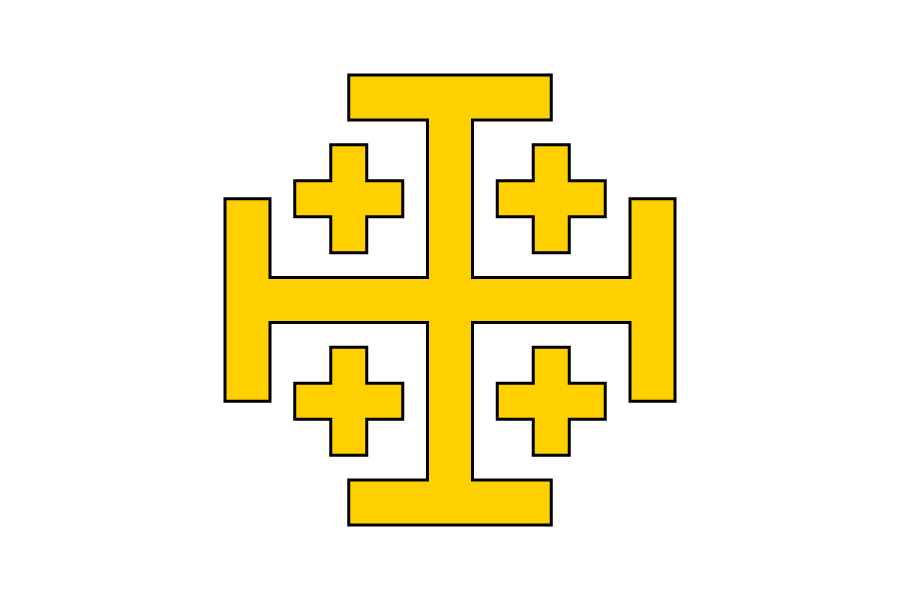
The Kingdom of Jerusalem was a Crusader state established in the Levant. For nearly two centuries, it served as a Western European outpost in the Middle East…
Contents
Overview
The genesis of the Kingdom of Jerusalem lies in the fervor of the First Crusade, which culminated in the capture of Jerusalem. Following this pivotal victory, the crusaders established a Latin Christian monarchy, with Godfrey of Bouillon adopting the title 'Advocatus Sancti Sepulchri' (Defender of the Holy Sepulchre). His successor, Baldwin I, formally assumed the royal title. The initial kingdom, stretching across territories that now encompass parts of Syria, Lebanon, and Israel, was a precarious entity, constantly defending its borders against resurgent Muslim powers. A critical turning point occurred when Saladin decisively defeated the crusader army at the Battle of Hattin and subsequently recaptured Jerusalem. This event fractured the kingdom, leading to its restoration during the Third Crusade. The re-established kingdom, now centered in Acre, continued as a significant Crusader presence for another century, though its territorial control waxed and waned with subsequent crusades and truces.
⚙️ How It Worked: Governance and Society
The Kingdom of Jerusalem operated as a feudal monarchy, structured much like its European counterparts, albeit with unique adaptations to its Levantine context. The king, theoretically an absolute monarch, was in practice constrained by powerful feudal lords, including the great barons of the realm such as the Ibelins, the Montforts, and the Bries. The kingdom's administration relied heavily on Latin clergy and a nascent bureaucracy, with officials like the Marshal and the Chamberlain managing military and domestic affairs. A significant aspect of its society was the presence of military orders, most notably the Knights Templar and the Knights Hospitaller, which held vast lands and wielded considerable military and political influence, often acting as independent power brokers. The population, estimated at around 565,000 at its peak, was a complex mix of Latin Christians, Eastern Christians, Jews, and Muslims, with Latin being the official language of administration and law.
📊 Key Facts & Numbers
At its zenith, the Kingdom of Jerusalem encompassed a territory of roughly 104,000 square kilometers. The estimated population of the kingdom hovered around 565,000 people, with a significant portion being indigenous Levantine populations rather than European settlers. The kingdom's military strength was a constant concern, with estimates suggesting it could field between 2,000 and 3,000 knights and a larger number of sergeants and infantry in times of crisis. The capital city, Jerusalem, was a focal point of pilgrimage, attracting tens of thousands of visitors annually before its fall in 1187. After the re-establishment in Acre, the city became a bustling port and administrative center, with its population fluctuating significantly based on the influx of crusaders and refugees. The kingdom's economy was largely agrarian, supplemented by trade through its coastal cities, which generated considerable revenue for the crown and its barons.
👥 Key People & Organizations
Key figures in the Kingdom of Jerusalem's history include its monarchs, such as Baldwin IV, the 'leper king,' whose reign was marked by military prowess despite his debilitating illness, and Melisende, the kingdom's most powerful queen regnant. Military leaders like Godfrey of Bouillon and Raymond IV of Toulouse were instrumental in its founding. On the opposing side, Saladin was the kingdom's most formidable adversary, orchestrating its near-total collapse in 1187. The powerful military orders, the Knights Templar and Knights Hospitaller, acted as quasi-independent entities, with Grand Masters like Robert de Craon (Templars) and Roger de Moulins (Hospitallers) wielding immense influence. The Ibelin family, particularly John of Ibelin, played a crucial role in the kingdom's legal and political development, especially during the regency periods.
🌍 Cultural Impact & Influence
The Kingdom of Jerusalem left an indelible mark on Western perceptions of the East, shaping European imagination for centuries. Its existence fueled the narrative of the Crusades, influencing art, literature, and religious thought across Europe. The architectural styles that emerged, a fusion of Romanesque, Gothic, and Byzantine influences with local adaptations, can still be seen in surviving castles and churches. The legal traditions developed within the kingdom, particularly the Assizes of Jerusalem, codified feudal law and influenced legal systems elsewhere. The very concept of a Latin kingdom in the Holy Land became a potent symbol of Christian endeavor and sacrifice, inspiring countless pilgrims and crusaders. Its eventual fall in 1291 marked a significant psychological blow to Christendom, contributing to a sense of loss and a re-evaluation of Eastern policy, as explored in works by figures like Marco Polo and later historians.
⚡ Current State & Latest Developments
The legacy of the Kingdom of Jerusalem continues to be debated and re-examined by historians and archaeologists. While the physical remnants of its castles and cities, such as Krak des Chevaliers (though technically outside its core territory, it was a major Crusader stronghold) and the ruins in Acre, are tangible links to its past, the political and cultural echoes are more subtle. Modern scholarship, particularly through archaeological excavations in Israel and Palestine, continues to uncover new details about daily life, military strategies, and interfaith relations within the kingdom. The ongoing geopolitical situation in the Levant also casts a long shadow, with contemporary discussions about sovereignty, religious claims, and historical narratives often referencing the era of the Crusader states, though direct parallels are fraught with anachronism. The academic study of the Crusades remains a vibrant field, with new research constantly challenging older interpretations.
🤔 Controversies & Debates
The Kingdom of Jerusalem is a subject of considerable historical debate. One major controversy revolves around the true intentions and motivations behind the Crusades themselves: were they primarily religious pilgrimages, land grabs, or a complex mix of both? The treatment of indigenous populations, including Muslims and Eastern Christians, by the crusaders is another contentious area, with accounts varying wildly from brutal oppression to periods of relative coexistence. The nature of power within the kingdom is also debated; the extent to which the kings truly controlled their powerful vassals and military orders remains a subject of scholarly inquiry. Furthermore, the long-term impact of the Crusader presence on the Levant's social, economic, and religious landscape is a topic of ongoing discussion, with some arguing for significant disruption and others for more nuanced, localized effects. The very concept of the 'Crusader states' as a unified entity is also questioned, with many scholars emphasizing the distinct characteristics and trajectories of each state.
🔮 Future Outlook & Predictions
The future outlook for understanding the Kingdom of Jerusalem lies in continued interdisciplinary research. Advances in archaeological techniques, such as remote sensing and advanced material analysis, promise to reveal more about its material culture and urban development. Digital humanities projects are increasingly being employed to reconstruct its administrative structures and social networks, potentially creating interactive maps and databases of its inhabitants and institutions. Comparative historical studies, examining the Kingdom of Jerusalem alongside other medieval frontier societies like Al-Andalus or the Teutonic Knights' state in Prussia, will likely yield new insights into its unique characteristics and broader historical significance. The ongoing quest to u
Key Facts
- Category
- history
- Type
- topic