Hebrew Calendar | Vibepedia
The Hebrew calendar, or Jewish calendar, is a lunisolar system meticulously designed to align lunar cycles with the solar year, a feat achieved through the…
Contents
- 🎵 Origins & History
- ⚙️ How It Works
- 📊 Key Facts & Numbers
- 👥 Key People & Organizations
- 🌍 Cultural Impact & Influence
- ⚡ Current State & Latest Developments
- 🤔 Controversies & Debates
- 🔮 Future Outlook & Predictions
- 💡 Practical Applications
- 📚 Related Topics & Deeper Reading
- Frequently Asked Questions
- References
- Related Topics
Overview
The roots of the Hebrew calendar are deeply entwined with the biblical narrative, with early indications of lunar observance found in the Torah itself, such as the commandment to observe the month of Nisan as the beginning of the year. For centuries, the Sanhedrin, the Jewish high court, relied on the testimony of eyewitnesses observing the new crescent moon to declare the start of each month, a practice that imbued the calendar with a dynamic, human-observed element. This system, however, proved vulnerable to manipulation and inconsistency, leading to the development of a fixed, calculated calendar. The pivotal shift occurred around the 4th century CE with the work of Rabbi Hillel II, who, facing the decline of the Sanhedrin and the diaspora, codified the perpetual Hebrew calendar based on mathematical principles. This transition from observational to calculated dating, finalized by the 10th century, established the 19-year Metonic cycle that continues to govern the calendar today, ensuring a consistent and predictable framework for Jewish life across the globe.
⚙️ How It Works
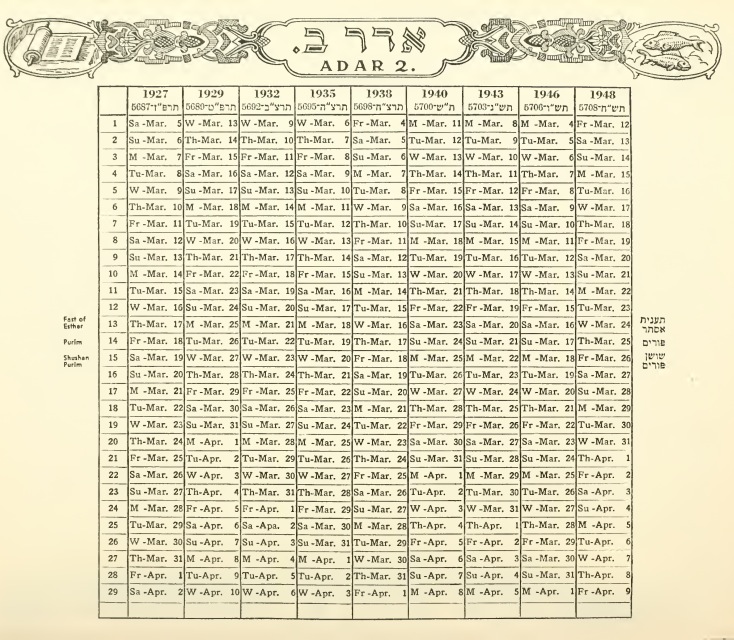
The Hebrew calendar is a lunisolar system, meaning it tracks both the moon's phases and the sun's annual cycle. Each month begins with the new moon, typically lasting 29 or 30 days. Twelve lunar months, however, fall short of a solar year by about 11 days. To compensate, an extra month, Adar II, is added seven times within a 19-year cycle (years 3, 6, 8, 11, 14, 17, and 19), a system known as the Metonic cycle. This intercalation ensures that holidays remain in their designated seasons; for instance, Passover always occurs in the spring. The year begins with the month of Tishrei, which contains the High Holy Days of Rosh Hashanah and Yom Kippur, though Nisan is considered the first month in terms of biblical commandments. The precise calculation of leap years and the start of months is governed by complex astronomical algorithms developed over centuries by Jewish scholars.
📊 Key Facts & Numbers
The Hebrew calendar comprises 12 months, with a 13th month added in 7 out of every 19 years, resulting in an average year length of approximately 365.2468 days, remarkably close to the solar year of 365.2422 days. A standard Hebrew year has 353-355 days, while a leap year (shanah me'uberet) has 383-385 days. The month of Cheshvan (also known as Marcheshvan) and Kislev can vary in length (29 or 30 days) to prevent holidays from falling on certain days of the week, a concept known as Dechiyah, which can shift the start of Rosh Hashanah by up to two days. The current Hebrew year, 5784, began on September 15, 2023, and will conclude on September 3, 2024. The calendar is currently in the 19th year of the 305th Metonic cycle since its calculated inception.
👥 Key People & Organizations
While the Hebrew calendar is a collective achievement of Jewish tradition, several figures stand out. Rabbi Hillel II is credited with formalizing the perpetual calendar around the 4th century CE, establishing the mathematical basis for its calculations. Later, scholars like Rabbi Saadia Gaon in the 10th century further refined and defended the calculated system against critics. The Sanhedrin, the ancient Jewish high court, played a crucial role in the earlier, observational phase of calendar determination. Today, organizations like Chabad-Lubavitch and various rabbinical councils continue to disseminate and interpret calendar information, ensuring its adherence within their communities. The State of Israel's Ministry of Interior is responsible for its official civil application.
🌍 Cultural Impact & Influence
The Hebrew calendar's influence extends far beyond religious observance. It shapes the rhythm of Jewish life, dictating the timing of holidays that are central to cultural identity and communal gatherings, such as Hanukkah and Purim. Its cyclical nature provides a framework for historical remembrance, with days like Yom HaShoah (Holocaust Remembrance Day) and Yom HaZikaron (Memorial Day) observed according to its dates. In Israel, the calendar is integrated into civil life, affecting school schedules, national holidays, and agricultural planning, demonstrating its deep symbiosis with the land and its people. The calendar's astronomical precision has also inspired awe and study, influencing mathematical and astronomical thought within Jewish intellectual history.
⚡ Current State & Latest Developments
As of 2024, the Hebrew calendar remains the primary temporal framework for Jewish religious life worldwide. Its adherence is maintained through religious institutions and educational programs, particularly within Orthodox and Conservative Judaism. In Israel, it functions alongside the Gregorian calendar, with official documents and events often bearing both dates. The ongoing development of digital calendar applications and smartphone integration has made accessing and understanding the Hebrew calendar more accessible than ever before, allowing individuals to easily track holidays, Shabbat candle-lighting times, and daily Torah portions. The calendar's continued relevance underscores its robust design and profound cultural significance.
🤔 Controversies & Debates
One of the most significant historical debates surrounding the Hebrew calendar involved the transition from an observational system, where the new month was declared by witnesses, to the fixed, calculated calendar. Critics, particularly in the early medieval period, questioned the accuracy and legitimacy of the calculated system, arguing it deviated from the biblical commandment to observe the new moon. Rabbi Saadia Gaon famously defended the calculated calendar in his work Sefer HaMo'adim, arguing for its necessity in the diaspora and its scientific accuracy. Another point of contention, though less widespread, involves the precise calculation of certain calendar adjustments (Dechiyah) and their theological implications, with minor variations in practice existing among different Jewish communities.
🔮 Future Outlook & Predictions
The future of the Hebrew calendar appears secure in its role as the spiritual and cultural anchor for Jewish observance. While the calculated system has proven remarkably stable for over 1600 years, ongoing discussions might arise concerning potential astronomical refinements or the integration of new technologies for calendrical calculations. The calendar's lunisolar nature, while precise, means it will always maintain a slight drift relative to the Gregorian calendar, ensuring its distinctiveness. As Jewish communities continue to thrive globally, the Hebrew calendar will persist as a vital thread connecting past, present, and future generations, a constant reminder of shared heritage and spiritual continuity.
💡 Practical Applications
The Hebrew calendar's most practical application is the scheduling of Jewish holidays and observances. This includes determining the dates for Shabbat, Rosh Chodesh (the new month), and major festivals like Sukkot, Pesach, and Shavuot. It also dictates the timing for Yahrzeits (anniversaries of a death), Bar Mitzvah and Bat Mitzvah celebrations, and the weekly cycle of Torah readings in synagogues. In Israel, it serves as an official calendar for civil purposes, influencing agricultural seasons and the timing of national remembrance days. Furthermore, it provides a framework for Kabbalistic and Chasidic practices, with specific days and months holding unique spiritual significance.
Key Facts
- Year
- c. 4th century CE (codification)
- Origin
- Ancient Israel
- Category
- culture
- Type
- concept
Frequently Asked Questions
Why does the Hebrew calendar add an extra month?
The Hebrew calendar is lunisolar, meaning it tracks both lunar cycles and the solar year. Twelve lunar months total about 354 days, falling short of the solar year by roughly 11 days. To keep holidays in their proper seasons, an extra month, Adar II, is added seven times within a 19-year cycle, a system known as the Metonic cycle. This ensures that festivals like Passover always occur in the spring, for example.
How was the start of the month determined historically?
Historically, the start of each Hebrew month, Rosh Chodesh, was determined by direct observation of the new crescent moon. Witnesses would report their sightings to the Sanhedrin, which would then declare the new month. This observational system was replaced by a fixed, calculated calendar around the 4th century CE, primarily due to the challenges of maintaining consistent observation across the diaspora.
What is the significance of the Hebrew calendar in Israel?
In Israel, the Hebrew calendar is an official civil calendar alongside the Gregorian calendar. It dictates the timing of Jewish religious observances, influences agricultural planning, and determines the dates for national remembrance days like Yom HaShoah and Yom HaZikaron. Many official documents and public notices in Israel will feature both Hebrew and Gregorian dates.
How does the Hebrew calendar differ from the Gregorian calendar?
The primary difference lies in their construction: the Gregorian calendar is purely solar, with a fixed number of days per year (365 or 366 in a leap year), while the Hebrew calendar is lunisolar. The Hebrew calendar uses lunar months (29 or 30 days) and adds an extra month periodically to align with the solar year, resulting in years that can range from 353 to 385 days. This lunisolar nature causes holidays to shift annually relative to the Gregorian calendar.
What are the main months of the Hebrew year?
The Hebrew year officially begins with the month of Tishrei, which contains the High Holy Days of Rosh Hashanah and Yom Kippur. However, the biblical first month is Nisan. The 12 months are Nisan, Iyar, Sivan, Tammuz, Av, Elul, Tishrei, Cheshvan, Kislev, Tevet, Shevat, and Adar. In leap years, an additional month, Adar II, is inserted.
How do I find out the Hebrew date for a specific Gregorian date?
Numerous online tools and apps are available to convert Gregorian dates to Hebrew dates and vice versa. Websites like Chabad.org or HebCal.com offer reliable converters. These tools utilize the complex algorithms of the Metonic cycle to accurately calculate the corresponding date, taking into account leap years and month variations. Many digital calendars also offer Hebrew date integration.
What are the future predictions for the Hebrew calendar's use?
The Hebrew calendar is expected to remain the cornerstone of Jewish religious observance for the foreseeable future. Its historical resilience and the deep cultural and spiritual significance it holds for Jewish people suggest its continued relevance. While technological advancements might influence how it's accessed and displayed, its fundamental structure and purpose are unlikely to change. Its role as an official calendar in Israel also ensures its continued integration into civil life.