Early Broadcasting | Vibepedia
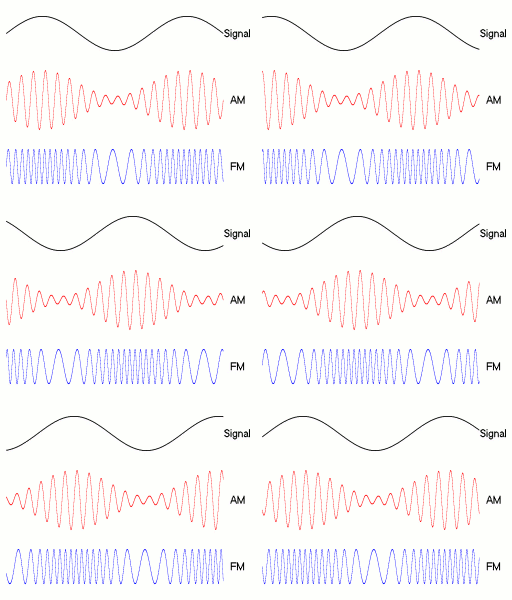
Early broadcasting refers to the pioneering era of radio transmission, marked by the development of amplitude modulation (AM) technology in the early 20th centu
Overview
Early broadcasting refers to the pioneering era of radio transmission, marked by the development of amplitude modulation (AM) technology in the early 20th century. The first experimental AM transmissions began in the 1900s, but it wasn't until the 1920s that widespread AM broadcasting took hold, ushering in the 'Golden Age of Radio'. This period, which lasted until the 1950s, saw radio become a dominant form of entertainment and news dissemination, with iconic figures like [[orson-welles|Orson Welles]] and [[edward-r-murrow|Edward R. Murrow]] making significant contributions. The rise of television in the 1950s led to a decline in radio's popularity, but AM broadcasting continued to evolve, with the introduction of [[fm-radio|FM radio]], [[digital-radio|digital radio]], and other technologies. Today, early broadcasting is recognized as a crucial milestone in the development of modern media, with its legacy continuing to influence the broadcasting industry. Notable broadcasters like [[nbc|NBC]] and [[cbs|CBS]] played a significant role in shaping the medium, while innovators like [[guglielmo-marconi|Guglielmo Marconi]] and [[lee-de-forest|Lee de Forest]] pushed the boundaries of radio technology. With over 100 million radios in use worldwide by the mid-20th century, early broadcasting had a profound impact on popular culture, paving the way for the diverse range of media platforms we see today.