Dravidian Languages | Vibepedia
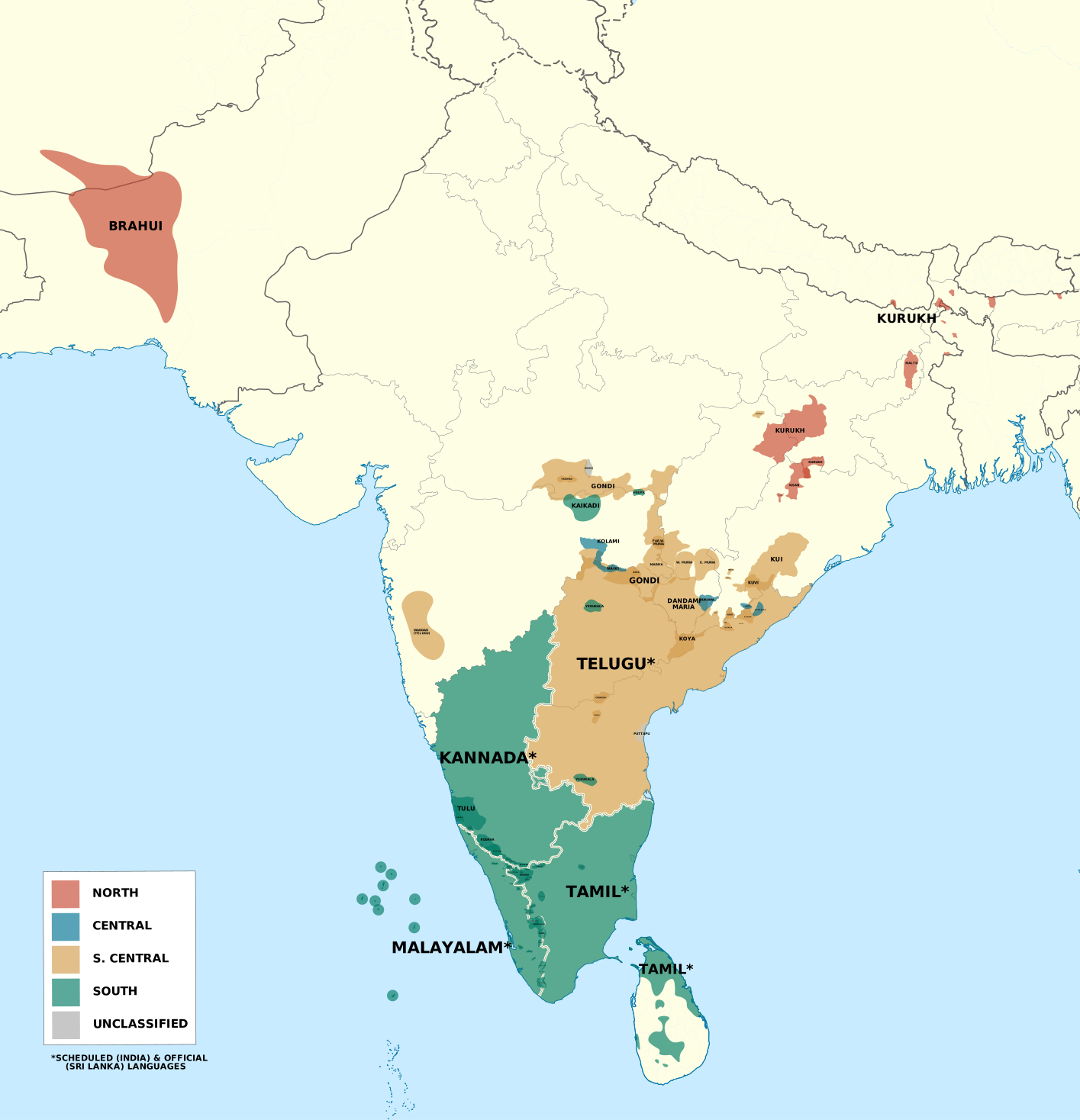
Significant Dravidian-speaking communities are present in Sri Lanka, Pakistan, Nepal, Bhutan, Bangladesh, Afghanistan, and Iran. Tulu and Kodava also possess…
Contents
Overview
The origins of the Dravidian language family are shrouded in antiquity. Early inscriptions in Old Tamil date back to at least 500 BCE, found on pottery shards and coins, providing concrete evidence of its ancient lineage. The major literary languages—Telugu, Tamil, Kannada, and Malayalam—developed distinct literary traditions over centuries, solidifying their status and influencing regional cultures. The spread of Dravidian speakers, often through migration and trade, also accounts for the presence of languages like Brahui in Pakistan and Kurukh in eastern India and Nepal, showcasing a remarkable historical diaspora.
⚙️ Linguistic Structure
Dravidian languages are characterized by agglutinative morphology, meaning words are formed by stringing together morphemes (units of meaning) without changing the root word's form significantly. This contrasts with the fusional morphology common in Indo-European languages, where endings often change to indicate multiple grammatical features simultaneously. For instance, in Tamil, the plural marker '-kal' is added to nouns, and case markers are appended sequentially. Most Dravidian languages exhibit a Subject-Object-Verb (SOV) word order, though variations exist, particularly in spoken dialects or for emphasis. They typically employ postpositions rather than prepositions, and adjectives generally precede the nouns they modify. Phonologically, many Dravidian languages distinguish between dental and retroflex consonants, a feature less common in Indo-Aryan languages, and possess a rich system of vowel harmony in some branches.
📊 Key Facts & Numbers
The Dravidian language family is a significant linguistic force, spoken by an estimated 250 million people worldwide. Collectively, the four major literary languages account for over 95% of all Dravidian speakers. Tulu, a significant non-scheduled language, has around 1.5 million speakers, primarily in coastal Karnataka and Kerala. Brahui, spoken in Balochistan, Pakistan, has an estimated 2-4 million speakers, making it a linguistic anomaly geographically distant from the main Dravidian heartland. The family comprises over 80 distinct languages, with many more dialects, spread across southern India and parts of neighboring countries.
👥 Key Scholars & Researchers
The study of Dravidian languages has been advanced by numerous scholars, both within India and internationally. Sir William Jones, a pioneering figure in comparative linguistics, first noted the distinctness of Dravidian languages from Sanskrit in the late 18th century, though his focus remained primarily on Indo-Aryan. Later, Robert Caldwell (1814–1891) published his seminal work, 'A Comparative Grammar of the Dravidian Languages' (1856), which systematically established the family as a distinct linguistic group and is still considered a foundational text. More recent significant contributions have come from Indian linguists such as M. S. Andronov, whose extensive research on Dravidian phonology and historical linguistics, particularly his work on Proto-Dravidian reconstruction, has been highly influential. Scholars like Sumitra M. Kulkarni and K. A. Nilakanta Sastri have also contributed significantly to understanding the historical and cultural context of these languages.
🌍 Cultural Impact & Influence
Dravidian languages have profoundly shaped the cultural and intellectual landscape of South Asia. Tamil, with its unbroken literary tradition spanning over two millennia, has been a vehicle for classical literature, philosophy, and devotional poetry, influencing art and architecture across the region. The Sangam literature, dating from around 300 BCE to 300 CE, represents some of the earliest extant secular literature in the world. Malayalam literature, known for its rich poetic traditions and dramatic forms like Kathakali, has also contributed significantly to Indian performing arts. Kannada has a strong tradition of poetry, prose, and inscriptions, with notable contributions to Jain and Veerashaiva literature. Telugu literature, particularly its devotional and courtly traditions, has been instrumental in shaping religious and political discourse. The distinct scripts used by these languages, such as the Brahmi-derived scripts, have also influenced writing systems across Southeast Asia.
⚡ Current State & Latest Developments
In the current linguistic landscape of 2024, Dravidian languages remain vibrant and dynamic. Telugu and Tamil continue to be major languages of commerce, education, and media, with robust film industries (Tollywood and Kollywood) that have significant national and international reach. Efforts are underway to preserve and promote endangered Dravidian languages like Tulu and Kodava through educational initiatives and cultural organizations such as the Tulu Sahitya Academy. The digital age presents both challenges and opportunities, with ongoing work in natural language processing (NLP) for Dravidian languages to improve machine translation and accessibility on platforms like Google Translate. The Brahui language, in particular, is seeing renewed efforts in documentation and revitalization by scholars and community leaders in Pakistan.
🤔 Controversies & Debates
The classification of Dravidian languages within broader linguistic frameworks remains a point of contention. The hypothesis linking them to the Nostratic macrofamily, a proposed super-family of languages spoken in Eurasia and North Africa, is highly speculative and not widely accepted by mainstream linguists due to the lack of robust evidence. Similarly, the theory of a Dravidian substratum influencing Indo-Aryan languages is debated; while some scholars point to shared grammatical features and loanwords, others argue these can be explained by other means. The precise relationship between the Dravidian family and other language families, particularly the hypothetical Vasconic languages of Europe (e.g., Basque), has also been a subject of fringe theories, though lacking mainstream academic support. The distinctiveness of Brahui from other Dravidian languages also sparks debate regarding its historical migration and linguistic divergence.
🔮 Future Outlook & Predictions
The future of Dravidian languages appears robust, particularly for the major tongues, driven by demographic growth and their continued use in education and media. However, smaller languages face the perennial challenge of globalization and the dominance of major languages, necessitating targeted preservation efforts. Advances in Artificial Intelligence and NLP are expected to play a crucial role in creating new digital resources and applications for Dravidian languages, potentially increasing their visibility and utility. There is also a growing interest in comparative Dravidian linguistics, with ongoing research aiming to refine the reconstruction of Proto-Dravidian and explore potential deeper connections to other language families. The cultural influence of Dravidian languages, particularly through cinema and literature, is likely to continue
Key Facts
- Category
- culture
- Type
- topic