Continuous Integration | Vibepedia
Continuous Integration (CI) is a software development practice where developers frequently merge their code changes into a central repository, after which…
Contents
Overview
Continuous Integration (CI) is a software development practice where developers frequently merge their code changes into a central repository, after which automated builds and tests are run. This approach, first conceptualized by [[grady-booch| Grady Booch]] in 1991, aims to detect integration errors as early as possible, preventing the accumulation of bugs and ensuring a consistently releasable codebase. CI is typically triggered by code commits, running builds and tests automatically to validate the integrity of the integrated code. Its widespread adoption, accelerated by tools like [[jenkins|Jenkins]] and [[gitlab-ci|GitLab CI]], has become a cornerstone of efficient and reliable software delivery pipelines, significantly reducing integration problems and improving team collaboration. The practice is often paired with Continuous Delivery (CD) and Continuous Deployment (CD) to form a complete DevOps workflow.
🎵 Origins & History
The genesis of Continuous Integration can be traced back to the early days of software development, where manual integration of code was a notoriously painful and error-prone process. In 1991, [[grady-booch|Grady Booch]] first articulated the concept, though his initial vision involved less frequent integration than the modern practice. The term gained traction and evolved significantly with the advent of [[extreme-programming|Extreme Programming (XP)]] in the late 1990s and early 2000s, which advocated for integrating code multiple times a day. Early adopters and proponents like [[marty-cagan|Marty Cagan]] and [[alec-shafersman|Alec Shafersman]] championed the benefits of this rapid feedback loop. The development of automated build and testing tools provided the necessary infrastructure to make CI a practical reality for development teams worldwide.
⚙️ How It Works
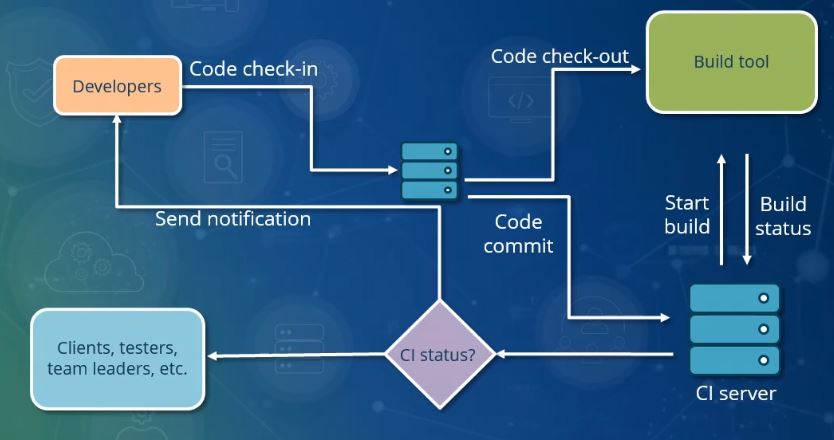
At its core, CI operates on a simple yet powerful principle: integrate early and often. Developers commit small, granular changes to a shared version control repository, typically [[git|Git]] or [[subversion|Subversion]]. Upon each commit, an automated CI server, such as [[jenkins|Jenkins]], [[circleci|CircleCI]], or [[github-actions|GitHub Actions]], is triggered. This server then performs a series of crucial steps: it checks out the latest code, compiles it (if necessary), runs a suite of automated tests (unit tests, integration tests, static analysis), and reports the results. If any stage fails, the team is immediately notified, allowing them to address the issue before it propagates further. This rapid feedback loop is the engine that drives CI's effectiveness in maintaining code quality and stability.
📊 Key Facts & Numbers
The impact of CI on software development velocity is substantial. The adoption rate of CI practices is estimated to be over 70% among professional software development teams globally. The market size for CI/CD tools exceeds $5 billion annually.
👥 Key People & Organizations
Several key figures and organizations have been instrumental in shaping and popularizing Continuous Integration. [[grady-booch| Grady Booch]], a renowned software engineer, is credited with coining the term in 1991. [[marty-cagan|Marty Cagan]], a prominent voice in product management and engineering, has extensively written about the importance of CI in building high-performing teams. [[alec-shafersman|Alec Shafersman]] and [[paul-hammant|Paul Hammant]] were early proponents and developers of CI tools and methodologies. Major technology companies like [[google|Google]], [[amazon-web-services|Amazon Web Services (AWS)]], and [[microsoft|Microsoft]] have integrated CI principles deeply into their development processes, often developing their own internal tools before contributing to open-source projects like [[jenkins|Jenkins]] and [[gitlab-ci|GitLab CI]].
🌍 Cultural Impact & Influence
Continuous Integration has fundamentally altered the culture of software development, shifting the focus from infrequent, high-risk integration events to a continuous, low-risk flow of changes. It fosters a culture of shared responsibility for code quality, as every developer's commit is immediately subject to automated scrutiny. This practice has enabled the rise of [[devops|DevOps]] and Agile methodologies, promoting closer collaboration between development and operations teams. The widespread adoption of CI has also led to a proliferation of specialized tools and services, creating a robust ecosystem around automated software delivery. Its influence extends beyond pure software engineering, inspiring similar integration and testing practices in fields like hardware design and data science.
⚡ Current State & Latest Developments
In 2024 and beyond, CI continues to evolve, driven by advancements in cloud computing, containerization, and AI. Modern CI platforms are increasingly integrated with cloud services, offering scalable build infrastructure and sophisticated testing environments. The rise of [[docker-com|Docker]] and [[kubernetes-com|Kubernetes]] has made it easier to create consistent build and test environments, further streamlining the CI process. AI is beginning to play a role in optimizing test selection, predicting build failures, and even automating some aspects of code review. Companies like [[github-com|GitHub]] (with GitHub Actions) and [[circleci|CircleCI]] are at the forefront of this evolution, offering more intelligent and integrated CI/CD solutions.
🤔 Controversies & Debates
While CI is widely embraced, debates persist regarding its optimal implementation and potential downsides. One common criticism is the 'flaky test' problem, where tests intermittently pass or fail without code changes, undermining confidence in the CI system. Another point of contention is the 'integration hell' that can still occur if CI is not managed rigorously, especially in very large teams or complex projects. Some argue that the emphasis on frequent commits can sometimes lead to a focus on quantity over quality in code changes. Furthermore, the initial setup and maintenance of a robust CI pipeline can require significant investment in infrastructure and expertise, posing a barrier for smaller organizations.
🔮 Future Outlook & Predictions
The future of CI is inextricably linked with the broader trends in software development and AI. We can expect CI systems to become even more intelligent, leveraging machine learning to predict potential issues before they arise, optimize test execution, and even suggest code fixes. The integration with [[devops|DevOps]] and [[gitops|GitOps]] will deepen, creating more seamless end-to-end automation from code commit to production deployment. Serverless CI/CD platforms will likely gain further traction, abstracting away infrastructure management. The challenge will be to maintain the human element of collaboration and critical thinking amidst increasing automation, ensuring that CI remains a tool to empower developers, not replace their judgment.
💡 Practical Applications
Continuous Integration finds practical application across virtually all software development domains. It is essential for web development, mobile app development, game development, embedded systems, and enterprise software. For instance, a web development team might use CI to automatically test new features for their e-commerce platform on every code push, ensuring that user-facing changes are functional and secure. Mobile developers use CI to automate the build and testing of iOS and Android applications, catching regressions before they reach end-users. Game studios leverage CI to manage complex build processes for multiple platforms, ensuring game assets and code are integrated correctly. Even in data science, CI principles are being applied to automate the testing and deployment of machine learning models.
Key Facts
- Category
- technology
- Type
- concept